
Addressing critical Penimbangan Coastal management issues requires moving beyond surface cleanups to reform systemic policies and shift community environmental mindsets.
Beyond the Surface Waters
Picture a sun-drenched morning at Penimbangan Beach in Buleleng Regency, Bali. Waves lap against the shore, volunteers gather for hatchling releases, and local visitors take in the coastal view. To an outsider, it looks like an idyllic paradise maintained by dedicated community stewards. But just beneath the surface, a complex battle is being fought every single day.
The community monitoring group known as Pokmaswas Penimbangan Lestari works tirelessly to preserve this delicate ecosystem. Their duties range from rescuing sea turtle eggs and operating hatcheries to carrying out coral reef rehabilitation, routine beach cleanups, and local environmental education. Yet despite their efforts, recurring threats such as massive floating marine debris, destructive fishing gear, and endangered turtle habitat disturbances continue to wash up on their shores.
Why do these problems persist despite endless cleanup efforts?
To answer this, a research team from the University of Science Education comprising Dania Faradillah, Ni Luh Putu Sri Puja Astuti, Rahelya Agita Br Singarimbun, Nadya Vega Permata Limu, Felicia Hisako Hartono, Adelia Jesikapna Ginting, and Berliana Clarasinta Br Pinem, conducted field observations, semi-structured interviews, and systemic analysis at Penimbangan Beach on July 4, 2026.
By applying the Iceberg Model, the study reveals why treating visible symptoms is never enough to solve complex environmental crises.
The Iceberg Model — A Framework for Deep Environmental Solution
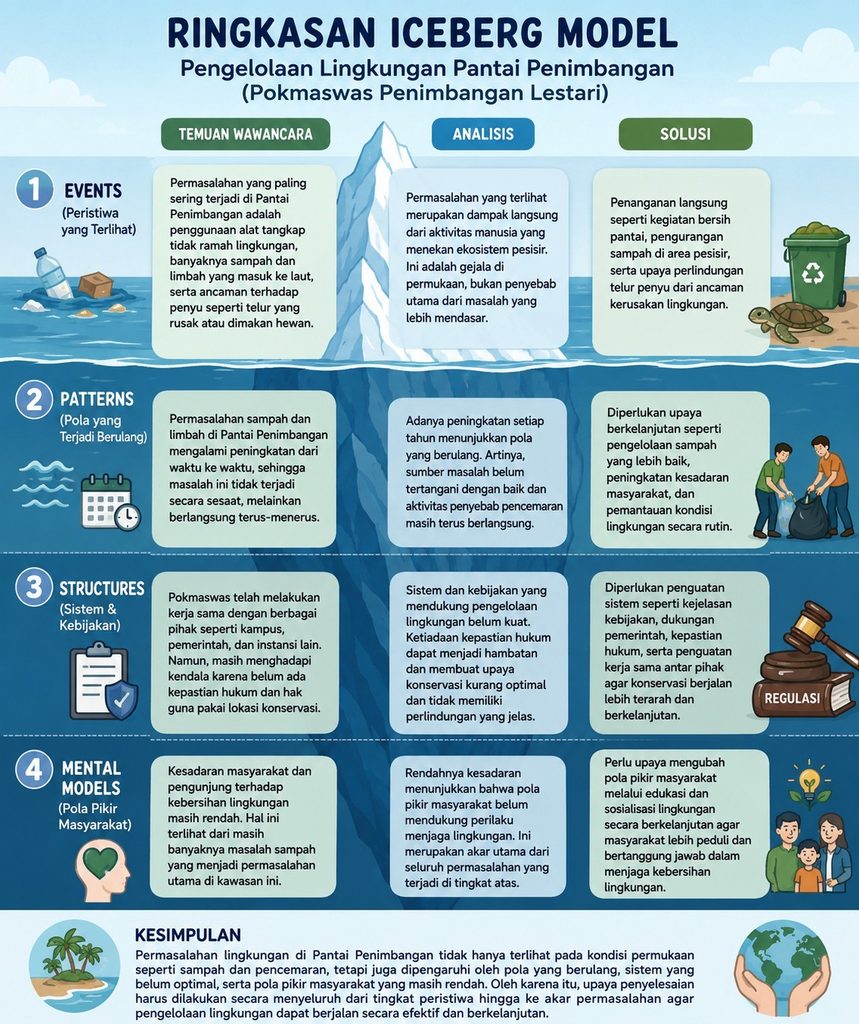
When looking at environmental degradation, most management strategies react only to what is visible. The Iceberg Model pushes researchers, policymakers, and communities to look deeper across four distinct layers:
- Events (The Surface): The immediate, visible symptoms (e.g., plastic waste on the beach).
- Patterns (Over Time): The recurring trends and historical occurrences (e.g., waste spikes every rainy season).
- Systemic Structures: The policies, infrastructure, governance, and resource allocations that enable the patterns.
- Mental Models (The Root Cause): The deeply ingrained mindsets, values, and societal beliefs that shape human behavior.
Layer 1: Events — What Is Visible on the Beach?
At the top layer of the iceberg are the daily events encountered by Pokmaswas Penimbangan Lestari during their routine patrols:
- Plastic Pollution & River Debris: Large quantities of trash continually drift into the coastal area.
- Destructive Fishing Gear: Ongoing use of non-environmentally friendly gear that harms marine flora and fauna.
- Turtle Habitat Threats: Nesting sites disturbed by human activities and animal predators, risking egg survival.
When environmental management operates exclusively at this surface layer, action is strictly reactive. Volunteers pick up plastic, re-bury turtle eggs, and issue warnings. While necessary for immediate survival, surface interventions do not prevent tomorrow’s trash from washing ashore.
Layer 2: Patterns — What Trends Are Emerging Over Time?
Moving below the water line reveals recurring patterns. The study identified clear, predictable cycles in the degradation of Penimbangan Coast:
- Seasonal Spikes: Trash accumulation peaks dramatically during the rainy season, driven by upstream rivers flushing inland waste into the ocean.
- Compounding Accumulation: The overall volume of waste and pollution has consistently increased year after year alongside growing coastal and upstream human activity.
- Continuous Operational Strain: Because waste flow is constant, the operational burden on Pokmaswas volunteers increases every year, stretching their limited capacity.
Recognizing patterns shifts management from simple reaction to anticipation. However, stopping the pattern requires altering the structures that generate it.
Layer 3: Systemic Structures — Where Are the Organizational Gaps?
Why do pollution patterns persist? The research highlights several structural, institutional, and legal bottlenecks facing local guardians:
- Lack of Legal Certainty: Pokmaswas Penimbangan Lestari operates without formal legal certainty or explicit management rights over the conservation area, limiting their authority to enforce rules or manage space permanently.
- Enforcement & Authority Limits: While volunteers execute patrols, they lack formal legal authority to penalize violators, relying solely on persuasive education.
- Infrastructure & Resource Deficits: Supporting facilities, surveillance gear, and funding remain strictly limited, forcing the team to rely on fragmented external assistance.
- Upstream-Downstream Policy Disconnect: Waste management policies in upstream river communities are not integrated with coastal protection strategies, leaving Penimbangan Beach vulnerable to inland runoff.
Without robust legal backing, structural funding, and integrated regional policies, local volunteer monitoring groups cannot scale their impact effectively.
Layer 4: Mental Models — The Root Cause Below the Surface
At the deepest level of the Iceberg Model lie mental models: the collective beliefs, cultural attitudes, and priorities of the public, visitors, and stakeholders.
The study concluded that the ultimate root cause of Penimbangan’s coastal environment issues is low public awareness and environmental indifference.
- Many individuals continue to view rivers and coastal areas as convenient disposal zones rather than interconnected living ecosystems.
- A significant portion of beach visitors and residents treat coastal sanitation as solely the government’s or Pokmaswas’s responsibility.
Until community mindsets shift toward shared environmental stewardship, structural fixes and cleanup drives will only offer temporary relief.
Key Interview Findings from Pokmaswas Penimbangan Lestari
| Focus Area | Primary Findings & Field Insights PDF |
| Core Operations | Coastal patrols, turtle egg rescue/hatching, hatchling releases, coral rehabilitation, beach cleanups, and public education. |
| Primary Threats | Destructive fishing gear, upstream waste delivered via rivers, and human/animal disturbance to turtle nests. |
| Major Bottlenecks | Limited volunteer personnel, lack of formal legal rights/authority, sparse infrastructure, and low public compliance. |
| Collaborators | Local government agencies, universities, academic researchers, and regional environmental groups. |
| Community Response | Mixed; while some residents actively participate, a substantial portion remains indifferent to environmental cleanliness. |
A Roadmap for Sustainable Coastal Action
To move beyond surface-level fixes, coastal management strategies must target all four layers of the iceberg simultaneously:
- Transforming Mindsets (Mental Models): Implement continuous, experiential environmental education for youth, business owners, and coastal visitors to foster a culture of shared responsibility.
- Strengthening Legal & Policy Frameworks (Systemic Structures): Grant formal legal management rights and clear mandates to community monitoring groups like Pokmaswas Penimbangan Lestari.
- Cross-Boundary Waste Governance: Establish integrated waste management policies connecting inland upstream river communities with coastal management teams to intercept waste before it reaches the sea.
- Empowering Community Guardship: Expand financial, logistical, and technological support for local conservation groups to sustain patrolling and habitat restoration initiatives long-term.
Conclusion
The work of Pokmaswas Penimbangan Lestari demonstrates the vital role community leadership plays in safeguarding marine biodiversity. However, protecting Penimbangan Coast requires addressing the systemic root causes beneath the surface. By combining legal recognition, cross-regional policy integration, structural funding, and dedicated mindset transformation, local coastal monitoring can evolve from a reactive struggle into a sustainable success story.
Article Contributor: Dania Faradillah, Ni Luh Putu Sri Puja Astuti, Rahelya Agita Br Singarimbun, Nadya Vega Permata Limu, Felicia Hisako Hartono, Adelia Jesikapna Ginting, Berliana Clarasinta Br Pinem